


SSF Insider vol.13


Fuji: Predictable Chaos (Which Is Somehow Worse)
Arriving at Fuji Speedway, the paddock braced itself for the usual Japanese weather routine: the kind where the sky opens, the track disappears, and drivers begin questioning their life choices somewhere between Turn 1 and aquaplaning into next week. Rain was forecast, expected, practically guaranteed. And yes, it did arrive. But not in the dramatic, apocalyptic fashion everyone had prepared for. Instead, Fuji delivered something far more irritating: indecision.
The race began on a wet track, just enough to keep everyone cautious and slightly uncomfortable, like driving a supercar through a car wash. Then, by lap 11, the circuit dried, lulling teams into a false sense of strategic competence. Halfway through, the rain returned, just to remind everyone who was in charge, before finally disappearing again as the track dried for the closing stages. It was less a weather pattern and more a confused rehearsal of one. We came expecting complete unpredictability, wild gambles, heroic tyre calls and spectacular misjudgements. Instead, we got something almost insulting in its clarity: the race made sense.

And that, frankly, is where things became deeply suspicious. Because while Fuji couldn’t decide whether it wanted to be wet or dry, Apex Motorsports suddenly remembered exactly what it wanted to be: dominant. After the Bathurst circus, where their cars seemed magnetically attracted to barriers, they arrived in Japan with the quiet determination of a team that had spent two weeks being shouted at by Melmut Harko in a dimly lit room. The result was immediate and, for everyone else, rather inconvenient. S2K returned to form with the calm authority of a man who had simply decided that mistakes were no longer fashionable. He controlled the race, adapted to the shifting conditions with irritating ease, and casually set the fastest lap just to underline the point. Behind him, Ryan slotted into second place without fuss, without drama, and most importantly, without incident, a detail that will not have gone unnoticed in the Apex garage.
The 1-2 finish was not just comfortable, it was clinical, the sort of performance that makes rival teams stare at their data screens and quietly consider new careers. With that result, Apex Motorsports performed a small act of championship sorcery, leaping from last place straight to the top of the teams’ standings with 73 points, while S2K now leads the drivers’ championship on 39. Two weeks ago, they looked fragile. Now they look like a problem.

After the race, Melmut Harko emerged to address the situation, which is always an event in itself. Asked whether the team had “found its form again,” he gave a long, theatrical pause, as though considering whether the question deserved an answer at all.
“We did not find anything,” he said eventually. “It was always there. We simply stopped doing stupid things.”
Pressed further on what exactly had changed since Bathurst, he replied,
“In Australia, we were very creative. Too creative. Here, we decided to be boring. You see the result.”
When it was suggested that the team now looked like championship favourites again, Harko dismissed the idea with the enthusiasm of a man rejecting a parking ticket.
“Favourites? No. This is racing. One mistake and you look like amateurs again. Ask us how we know.”
And there it is: Fuji, the race that was supposed to deliver chaos, instead handed control straight back to the reigning champions. Which, in its own strange way, might be even more unsettling. Because unpredictability is one thing; the sudden return of a perfectly functioning Apex Motorsports is quite another.

Old Teammates, New Enemies: Larson vs. Alex Ignites
Larson, a man who arrived at Fuji carrying the kind of reputation that usually makes other drivers nervously check their mirrors before the race has even started. This time, however, he qualified a rather uninspiring P9 and dropped to 11th immediately, which in Larson terms is not just below par, it’s practically a public apology. For a driver known for terrifying dominance, it was the sort of performance that makes you wonder whether he’d accidentally shown up to the wrong circuit.

But races, as we know, are rarely polite enough to follow qualifying form. And Larson, to his credit, decided that starting ninth was more of a suggestion than a limitation. What followed was a climb through the field that was equal parts impressive and mildly controversial, the kind of drive where brilliance and chaos travel in the same car. By the end of it all, he had dragged himself back to P3 and was looming large in Ryan’s mirrors, finishing less than half a second behind, which is close enough to make a point without quite being able to cash it in.
The journey there, however, was anything but clean. Fuji became the latest chapter in what is quickly turning into a rather spicy relationship between Larson and his former teammate Alex Strobel, now flying the flag for Scorpio. Their on-track encounters had all the subtlety of two people arguing in a supermarket aisle, neither willing to back down, both convinced they are entirely in the right. Add to that another robust exchange with Grammenos, also in Scorpio colours, and suddenly Larson’s race looked less like a calculated charge and more like a travelling dispute resolution service.
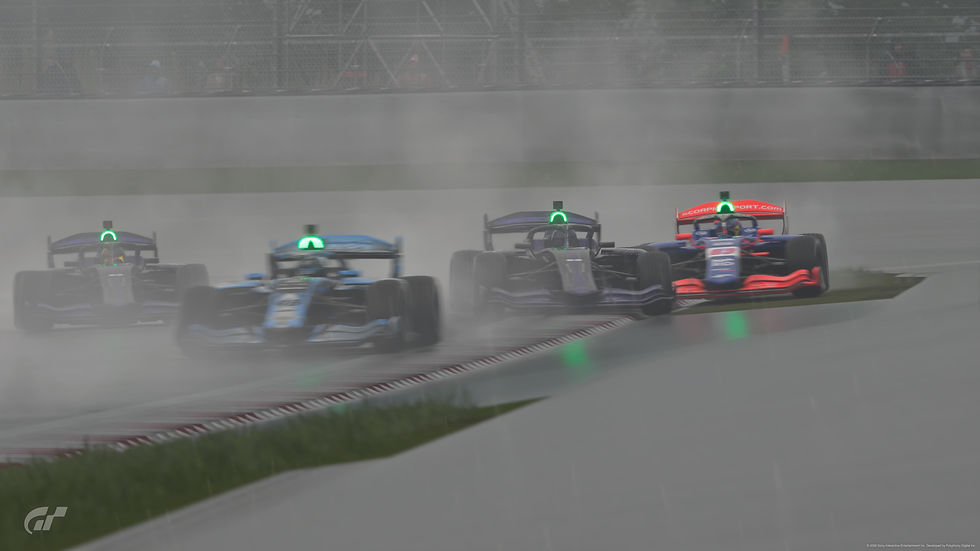
The stewards, as they so often do, felt the need to get involved. Penalties were handed out, eyebrows were raised, and somewhere in the background, engineers sighed into their headsets. Larson, however, managed to cling on to P3 even after the time penalties were applied, which only added to the sense that he was operating in his own slightly chaotic orbit. The real damage came elsewhere: four licence penalty points now sit next to his name, and with a limit of twelve, that’s the sort of number that starts to feel uncomfortably real when the season is only just getting going.

In the standings, the picture is… complicated. Larson finds himself down in fifth after the opening two rounds, which is not where anyone, least of all Larson himself, expected him to be. Meanwhile, his teammate Ekro endured a far less heroic afternoon, struggling in the wet, making multiple mistakes, and eventually limping home in 12th. The combined effect is rather brutal: FoxHound, once whispered about as the looming threat to Apex, now sit firmly at the bottom of the teams’ standings, which is not so much a statement as it is a warning.
And then, quietly but very effectively, there is Alex Strobel. Promoted to fourth after penalties were applied to Supa, he now sits third in the championship, just five points behind S2K. The former teammate dynamic between Alex and Larson is no longer a subplot; it is becoming one of the defining tensions of the season, a slow-burning rivalry that seems destined to erupt properly at the worst possible moment.
Which leaves us with the inevitable question, the one hovering awkwardly over the entire Fuji weekend: is Larson still a title contender? On raw pace alone, you would be foolish to say no. Drivers do not simply forget how to be that fast. But pace without control, speed without precision, and aggression with a growing collection of penalty points: that is a far more fragile combination than it looks. The talent is undeniable. The execution, however, is beginning to look… negotiable.
Simpulse: Fast, Funny… and Slightly Self-Destructive
If Apex Motorsports spent Fuji reminding everyone how to behave like champions, Simpulse arrived to demonstrate the exact opposite: how to be fast, entertaining, and just chaotic enough to trip over your own success.
Take Supa, for instance. On paper, it doesn’t look too bad: a recovery drive from 12th to 4th on the road, which in most racing circles would earn a polite nod and perhaps a firm handshake. But this is SSF, where nothing is ever quite that simple. Because while Supa was busy carving his way back through the field after an early spin on lap one - a moment of enthusiasm that immediately put him on the back foot - he also decided that defending his position should involve the sort of urgency usually reserved for escaping a burning building. The result? Two separate 5-second penalties for his rather… animated interactions with Alex Strobel and Grammenos, dropping him from fourth to fifth by the time everything was settled.

So yes, it was a good recovery drive. Impressive, even. But also entirely unnecessary in the way that locking your keys inside your own house is unnecessary. You can admire the solution while quietly questioning the problem.
Meanwhile, A. Guzman took a very different approach. Where Supa was all elbows-out aggression and strategic improvisation, Guzman opted for something far more radical: calmness. He kept it tidy, avoided drama, and brought the car home in a solid P6, which, in a race like Fuji, is the motorsport equivalent of keeping your suit clean at a food fight. It may not grab headlines, but it gets the job done.
And yet, despite these respectable results, Simpulse leave Fuji having lost their grip on both the drivers’ and teams’ championship leads. Which raises an uncomfortable but necessary question: are they quick enough to win a title, or just chaotic enough to make it entertaining?
Part of the intrigue lies not just in their performance, but in their… rather unconventional team dynamic. While most teams operate behind carefully constructed PR walls, delivering rehearsed lines about “maximising performance” and “learning from the weekend,” Simpulse have decided to do something far more dangerous: they’ve let their drivers speak. Publicly. To each other.
“Do you see what I have to deal with?”
Supa remarked, after Guzman once again took a playful jab at him. To which Guzman, without missing a beat, fired back:
“Yoo, when’s that article coming out? - most likely relating to the new issue of SSF Insider - I wanna see Supa get strays.”
This is not the language of a tightly controlled corporate racing outfit. This is the language of two drivers who seem to enjoy the chaos almost as much as the racing itself. And frankly, it’s brilliant. In a paddock often suffocated by politeness and PR-approved smiles, Simpulse feel like a breath of fresh air, or perhaps a gust of wind that’s just strong enough to knock things over.

But here’s the catch. Motorsport, for all its drama and personality, is still a results business. And while humour might win fans, it doesn’t win championships. The question now is whether this carefree, slightly mischievous approach can survive the pressure of a title fight, especially with Apex Motorsports suddenly remembering how to dominate.
Because joking around is easy when things are going well. It becomes considerably more complicated when every point matters. And Simpulse, as Fuji has just demonstrated, might be about to find out exactly where that line is.
The Veterans: Quietly Brilliant, Loudly Ignored
While the spotlight at Fuji was busy chasing winners, penalties, and mild organisational chaos, two names quietly went about their business with the sort of consistency that doesn’t make headlines, but probably should. Grammenos, for starters, delivered what can only be described as a stubbornly impressive performance. Driving with a broken finger and a pulled wrist, which for most people would be a perfectly valid excuse to sit down and complain loudly, he instead dragged the car to yet another P7 finish. That’s two races, two seventh places, and a steady stream of points for Scorpio. It wasn’t glamorous, it wasn’t dramatic, but it was the kind of effort that keeps a season alive while others are busy throwing theirs into gravel traps.

Right behind him, almost as if following a carefully written script, was RyBird, who even led the race at some point and once again crossed the line in P8. For the second time in a row. At this point, we’re beginning to suspect this isn’t coincidence but some sort of deeply committed personal branding exercise. In fact, we’ve already submitted a formal request to the championship organisers to change their numbers accordingly: Grammenos as 77, RyBird as 88, just to save everyone time.

Jokes aside, though, there’s something rather admirable about this kind of consistency. In a series where chaos is practically a requirement, both drivers are quietly building solid campaigns, race by race, point by point, like two accountants accidentally trapped in a circus.
Further down the order, the midfield delivered its usual mix of effort and survival. Returning drivers Steve “Equus Ferrum” and FoxHound’s new third driver Vader secured P9 and P10 respectively, doing exactly what was required and nothing more, which, given the conditions, is often the smartest approach. Kelly, also known as Method, brought the Scorpio car home in P11, just ahead of a struggling Ekro in P12, whose Fuji weekend will likely be filed under “less said, the better.” Rounding out the field was Simpulse’s newcomer Sam in P13, who, in fairness, at least managed to stay out of the sort of trouble that consumed others earlier in the race.

So while Fuji may not have delivered headline-grabbing heroics for everyone, it did, once again, highlight a simple truth: in SSF, being quietly effective is often far more valuable than being spectacularly inconsistent. Even if nobody notices at the time.
New Allies, Same Obsession: SF Finds Its Voice
Just when you thought Scorpio Super Formula was only about drivers arguing over apexes and occasionally using each other as braking markers, something rather refreshing has emerged from the chaos - a partnership that actually makes sense.

Enter Sim Racing Nation and Grid Geeks, two names that don’t just talk about racing but actively throw themselves into it with the kind of enthusiasm usually reserved for people who have discovered caffeine for the first time. Led by Eric Mojstrovich, a man who appears to love Super Formula as much as the rest of us (which is already slightly concerning), they have taken on the noble task of broadcasting the top split of Super Formula on iRacing and SimSpeed: where, incidentally, Timothy Friis Larsen continues to fly the flag for Scorpio.
This is the official Super Formula series, with thousands of drivers, run for 12 weeks by iRacing themselves - and the top split means the top drivers in the world (similar to GTWS in GT7), where Scorpio are represented by Tim and where we actively scout drivers for further promotion and potential real-life opportunities alongside Jason Käsmann.
Now, this might not sound revolutionary at first, but here’s the important bit: never before has Super Formula’s top split been broadcast on official iRacing channels. It has existed, fast and furious, hidden in plain sight like a secret too good for its own good. And now, thanks to SRN and Grid Geeks, it finally has a stage. Which is exactly why Scorpio decided to get involved. Because when you find people who are just as obsessed with open-wheel racing as you are, you don’t ask questions - you shake hands and get on with it. It’s a natural fit, a partnership built not on corporate nonsense, but on a shared belief that cars without roofs are simply better.
This collaboration isn’t just about broadcasting races; it’s about pushing the visibility of open-wheel racing, giving it the platform it probably should have had all along, and doing so with people who actually care about what they’re showing, and providing drivers with opportunities to be scouted by a real race team. There’s passion here, and in motorsport, that still counts for something.
If you want to see what this is all about, you can check out the official announcement here: iRacing weekly update: https://www.iracing.com/iracing-weekly-tune-in-esports-community-events-march-18th-to-march-25th-2026/

Scorpio, for its part, is clearly in this for the long haul. We see the potential, we see the passion, and most importantly, we see people who are willing to do the work.
And in a world where everyone claims to love racing but few actually do anything about it, that might just be the most important partnership of all.
This initiative is being promoted and coordinated by James Burn, Jamie Burn, Andrew Peddie, Marc Ponic, Gerhard Roets, Tony Dibden and Alan Strovich, working together on behalf of the community.
Autopolis Preview: Order? Don’t Be Ridiculous.
Two rounds into the season, and already Scorpio Super Formula has done something rather inconsiderate: it has refused to behave. Two races, two completely different podiums, six different drivers spraying champagne like they’ve just discovered it for the first time. If you were hoping for a neat, predictable championship narrative… I’m afraid you’ve come to the wrong circus.
Now we arrive at Autopolis, another stop in Japan, the spiritual home of Super Formula, where the circuits are fast, technical, and just narrow enough to make every mistake feel deeply personal. It’s the kind of track that doesn’t shout at you; it quietly waits for you to get it wrong, and then punishes you with the cold efficiency of a disappointed teacher.

On paper, you might say Apex Motorsports have regained control. Fuji was tidy, dominant, almost suspiciously competent. S2K leads the standings, the team sits comfortably at the top, and for a brief moment it looks like order has been restored. But this is exactly the sort of moment where SSF tends to do something deeply unhelpful, like throwing that order out of the nearest window.
Because lurking just behind are drivers who have already shown they’re more than capable of ruining a perfectly good prediction. Alex Strobel is right there in the standings, close enough to make things uncomfortable, and carrying the kind of quiet momentum that tends to explode at precisely the wrong moment for everyone else. Larson, meanwhile, is the great unanswered question. Blisteringly fast, occasionally chaotic, and now carrying just enough penalty points to make things interesting: he’s either about to launch a title charge… or accidentally set fire to it.
And then there’s the rest of the grid, which so far has behaved less like a hierarchy and more like a shuffled deck of cards. One week you’re on the podium, the next you’re explaining to your engineer why gravel seemed like a good idea. Consistency, at this stage, feels less like a skill and more like a rumour. Autopolis, however, has a habit of exposing things. It doesn’t care about your reputation, your past victories, or how many followers you have. It cares about precision, rhythm, and whether you can keep it together when the track starts asking difficult questions. And given what we’ve seen so far this season, “keeping it together” might be a slightly ambitious goal for some.
So what are we expecting? Naturally, chaos. Strategy gambles. Someone unexpected appearing at the front. Perhaps another new name on the podium, just to keep the statisticians awake at night. Or, and this is the truly unsettling possibility, perhaps Apex will simply continue where they left off, calmly dismantling the competition while everyone else argues over second place.
Either way, one thing is certain: if the first two rounds have taught us anything, it’s that predicting SSF right now is like trying to forecast the weather with a coin toss.
Autopolis is waiting.
P.S. Special thanks to one and only SSF GT7 streamer and commentator Aaron aka Blade, thanks to whom the group of anonymous journalists are able to watch races and laugh at drivers.


Comments